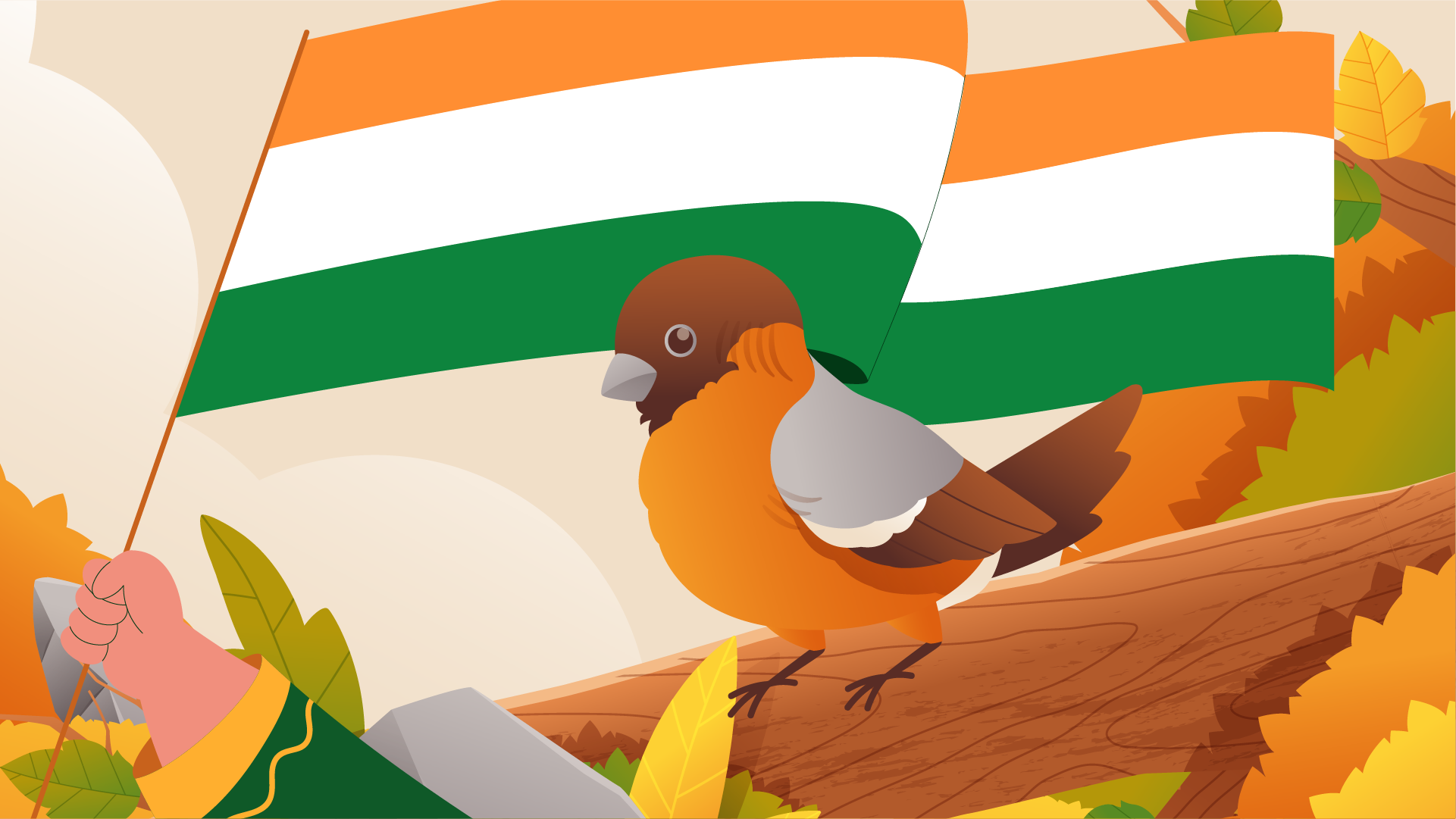
Imagine a land that is so prosperous, culturally alive, and self-sufficient that travelers from all over the world could only describe it as a “golden sparrow.”
India, once a dazzling, abundant, and admired nation for centuries, has undergone significant changes in its history.
When the European colonizers arrived, a tremendous amount of wealth was drained, and the “sparrow” lost a significant amount of its glitter.
Let’s examine why India was given the moniker “Sone ki Chidiya,” which means “Golden Sparrow” in literal translation. Whether or not India remains that golden sparrow now is perhaps a more significant question.
India before the British: A land of gold and abundance.
India, a vital economic powerhouse, was a vital hub of global trade before European ships arrived.
India was responsible for around 25–35% of the world’s gross domestic product (GDP) during the 16th and 17th centuries. Merchants from Arabia, Persia, China, and Europe sailed for months in order to acquire Indian textiles, particularly cotton and silk.
Indian ports became busy hubs as a result of the spice trade, which included the trading of pepper, cardamom, turmeric, and cinnamon. In addition to the finest craftsmanship in the world, precious diamonds from Golconda, excellent steel from southern India, and other elements contributed to the overall brightness.
To a significant extent, India was self-sufficient. When foreign merchants bought Indian goods, they were frequently required to pay for them in gold and silver, which only served to increase India’s wealth.
What was India named before the colonizers arrived?
From long time ago, India was known as Bharat, a name that was derived from the ancient king Bharata, whose narrative is found in the Mahabharata.
Poets would refer to India as Aryavarta, which means “the land of the noble people.” India is also known as “Jambudvipa,” a term that originated from the ancient Indian concept of dvīpa, meaning “island” or “continent” in cosmic geography. Emperor Ashoka referred to his vast realm as Jambudvipa in the 3rd century BCE.
Travelers from other countries have unique names, such as Sindhu, which means “mighty Indus River” in Sanskrit, which Persians struggled to pronounce, leading to the region’s name. It was adopted by the Greeks, who then gave it the name Indos. Both the Romans and the Europeans were responsible for the spread of the term “India” across the globe over the course of time.
Bharat, despite its name, remained a land of abundance, thriving in prosperity, art, and wisdom.
European traders turned rulers.
The British East India Company arrived in Surat in 1608. Initially, they looked like nice and innocent traders. They came with gold and silver to trade for spices, silk, and cotton. But over time, they started to weave a different kind of fabric—one of power, control, and armed strength.
As they entered Bengal, the Nawab of Bengal, Siraj-ud-Daulah, led the Battle of Plassey on June 23, 1757. The Nawab was upset with the Company’s abuse of trade rights, unfair taxation, trade practices, and position building without his consent. However, betrayals from Siraj-ud-Daulah’s army led to the Company exploiting internal conflicts for power.
The British victory at the Battle of Plassey in 1757 marked the beginning of British rule over Bengal, followed by the Battle of Buxar in 1764. The Battle of Buxar, fought in 1764, resulted from the British East India Company’s expansionist efforts and the defeat of Bengal’s Nawab Mir Qasim.
The East India Company, which had been a trade organization in the past, was now in charge of governing provinces, collecting taxes, and determining the future of India.
The British rule in India spanned two centuries, officially beginning in 1858, leading to organized political resistance and the Quit India Movement in 1942 that led to the widespread freedom movement.
Until India got its independence from the colony on August 15, 1947, one thing that didn’t change was that India’s wealth went outward instead of inward.
The great economic drain.
From 1765 to 1945, Britain plucked India dry of an estimated $45 trillion in wealth, according to economists. That would be enough to radically alter world economies in today’s money, at about $65 trillion.
How did this drain happen?
India was subjected to trade manipulation, exporting raw materials at low prices, and importing expensive British goods. Farmers were heavily taxed, leading to debt and poverty.
India also paid for Britain’s administrative and military expenses, sending large amounts back for officials and officers. Traditional Indian industries were destroyed to enable British factories to dominate.
The British empire had already been weakened by the time they were forced to face World War II. When it came to liberation, the Indian people’s demand became irrepressible. In 1947, India accomplished its long-awaited goal of regaining its independence, although at the excruciating expense of Partition.
India had lost its status as the Golden Sparrow by the time the British departed in 1947. Its contribution to global GDP dropped from 25% to 30% to 3%. There was widespread poverty, recurrent famines, and crippled industries.
Is India still the “Golden Sparrow”?
Yes, in certain respects; nevertheless, in other respects, it is still in the process of rebuilding.
India, once the fifth-largest economy globally, has made significant progress since its initial breakup in 1947, maintaining a nominal GDP of over $4 trillion.
India has lately surpassed Japan to become the fourth largest economy in the world in terms of nominal GDP. This position was achieved in the year 2025. In the year 2025, the nominal gross domestic product of India is approximately $4.19 trillion. As a result of this expansion, India is currently ranked in the world economy just behind the United States ($30.5 trillion), China ($19.2 trillion), and Germany ($4.74 trillion).
India, a global hub for various industries, boasts a young population and significant human capital. Its culture, from Bollywood to yoga, inspires people worldwide, making it a vital hub for information technology, pharmaceuticals, textiles, and space research.
The sparrow, despite regaining strength, faces challenges such as poverty, inequality, unemployment, and infrastructure gaps, necessitating inclusive growth and sustainable development.
What if the wealth had never been drained?
If the $45-65 trillion looted from India had stayed within its borders, India could have industrialized earlier, built strong infrastructure, reduced poverty and hunger, and become a superpower. Instead, India had to rebuild from scratch in 1947, but the resilience of its people has been extraordinary.
Final Thoughts:
India’s remarkable journey from the Golden Sparrow to a colonized land and back to a rising global power is a testament to its rich history.
Sone ki Chidiya, a historical reality, refers to India’s wealth and popularity, which was largely drained by the British. Despite the scars left by the British, India continues to rise, like a sparrow surviving storms.
India’s resilience, culture, and spirit are gaining strength each year, suggesting that its true gold lies not only in its economy but also in its resilience.
It sounds like India used to be the Golden Sparrow. Of course.
Is it turning into one again? Without any doubt, yes.