The Vedas, ancient sacred books in Vedic Sanskrit, are crucial to India’s cultural and spiritual history, preserving an unparalleled oral tradition for thousands of years. These sacred books serve as a repository of history, philosophy, poetry, ritual, and metaphysics.
This article carefully explains the structures of all four Vedas—the Samhitas, the Brahmanas, the Aranyakas, and the Upanishads—understanding layers, historical background, and current relevance.
Samhitas: The hymns of praise and power.
The Samhitas, the earliest and most fundamental layer of the Vedas, consist mainly of hymns (suktas), chants, and mantras used in rituals and prayers.
Rigveda Samhita
The most well-known is the Rigveda Samhita, which has 1,028 hymns which are grouped into ten mandalas. These hymns were composed to honor gods like Agni (fire), Indra (thunder and rain), Varuna (cosmic order), and Soma (the holy drink). For example, the song “Agni mile purohitam” at the beginning of the Rigveda talks about fire as the god who connects people with the gods.
Samaveda Samhita
In the Samaveda, many exerpts are used again in Samhita, but they are rearranged as melodies. The songs were intended to be sung during sacrifices, demonstrating the spiritual significance of sound and rhythm in uniting people. Some experts even think that the Samaveda was one of the first pieces of music that became Indian classical music.
Yajurveda Samhita
The Yajurveda Samhita has the sacred formulas (yajus) that priests say during sacrifices. The Rigveda is poetic, but the Yajurveda is practical. It gives clear directions on how to make offerings to keep the cosmic order.
Atharvaveda Samhita
The Atharvaveda Samhita has songs that can be used in everyday life to heal illnesses, bring wealth, ward off evil, or promote peace. It has charms for health and gifts for homes, for example, which shows that Vedic spirituality has a very human side to it.
Brahmanas: rituals, rules, and symbolism.
Because of the development of Vedic culture, rituals got increasingly complicated. These rituals were described in the prose Brahmanas, which were written in order to shed light on the purposes and procedures of the ceremonies.
Role of the Brahmanas
Each Brahmana text is linked to a specific Veda. For example, the Aitareya Brahmana belongs to the Rigveda, the Shatapatha Brahmana is attached to the Yajurveda, the Tandya Brahmana is associated with the Samaveda, and the Gopatha Brahmana connects with the Atharvaveda.
The elaborate processes of sacrifices, known as Yajnas, are described in these writings. Some examples of Yajnas include the Ashvamedha (a horse sacrifice) and the Agnihotra (a fire rite). These activities are also interpreted by them in terms of their symbolic meaning. For example, in the Shatapatha Brahmana, the construction of a fire altar is linked to the creation of the universe, with each brick representing a different facet of the universe.
Example of Symbolic Ritualism
An example that is particularly stunning is found in the Aitareya Brahmana, which provides an interpretation of the cosmic importance of Indra’s victory over the serpent Vritra. The myth serves as a narrative about the supernatural’s triumph and a metaphor for the release of essential life-sustaining waters, symbolizing fertility and abundance.
The Brahmanas serve as manuals for rituals and commentary on symbolic meanings, representing a civilization where religious practice was intricately linked to society’s order and cosmos.
Aranyakas: Reflections of the forest.
A change in spiritual orientation is indicated by the Aranyakas, often known as the “forest texts.” Hermits, ascetics, or advanced practitioners who retired from active social life and went into forests for contemplation were the intended recipients of these practices, despite the fact that they were still connected to ritual.
Why “Forest Texts”?
In contrast to the Brahmanas, which are comprehensive manuals to ceremonies, the Aranyakas are interpretations of those rituals via the practice of meditation. Ceremonies are called into question, symbolized, and reinterpreted by them, frequently in a more abstract manner.
In the Taittiriya Aranyaka of the Yajurveda, for example, there is a discussion on the symbolic meaning of the Gayatri mantra, as well as a meditation on the role of sound in the cosmos. As an alternative to training students on how to construct an altar, the Aranyakas would investigate the meaning of the altar, which may be the human body, the universe, or awareness itself.
The Aranyakas act as a connection between the external rituals and the inside philosophy of the community. They lay the groundwork for the Upanishads, which dedicate a significant portion of their content to the investigation of the ultimate truth by direct inquiry.
An illustration of this can be found in the Brihadaranyaka Upanishad, which, although it is more accurately classified as an Upanishad, originates from the Aranyaka tradition.
It poses life-changing questions, such as, “What is the Self?” What exactly is the real nature of things? These kinds of inquiries illustrate the gradual transition from a religiously ceremonial approach to a philosophically spiritual one.
Upanishads: The philosophy and the quest for truth.
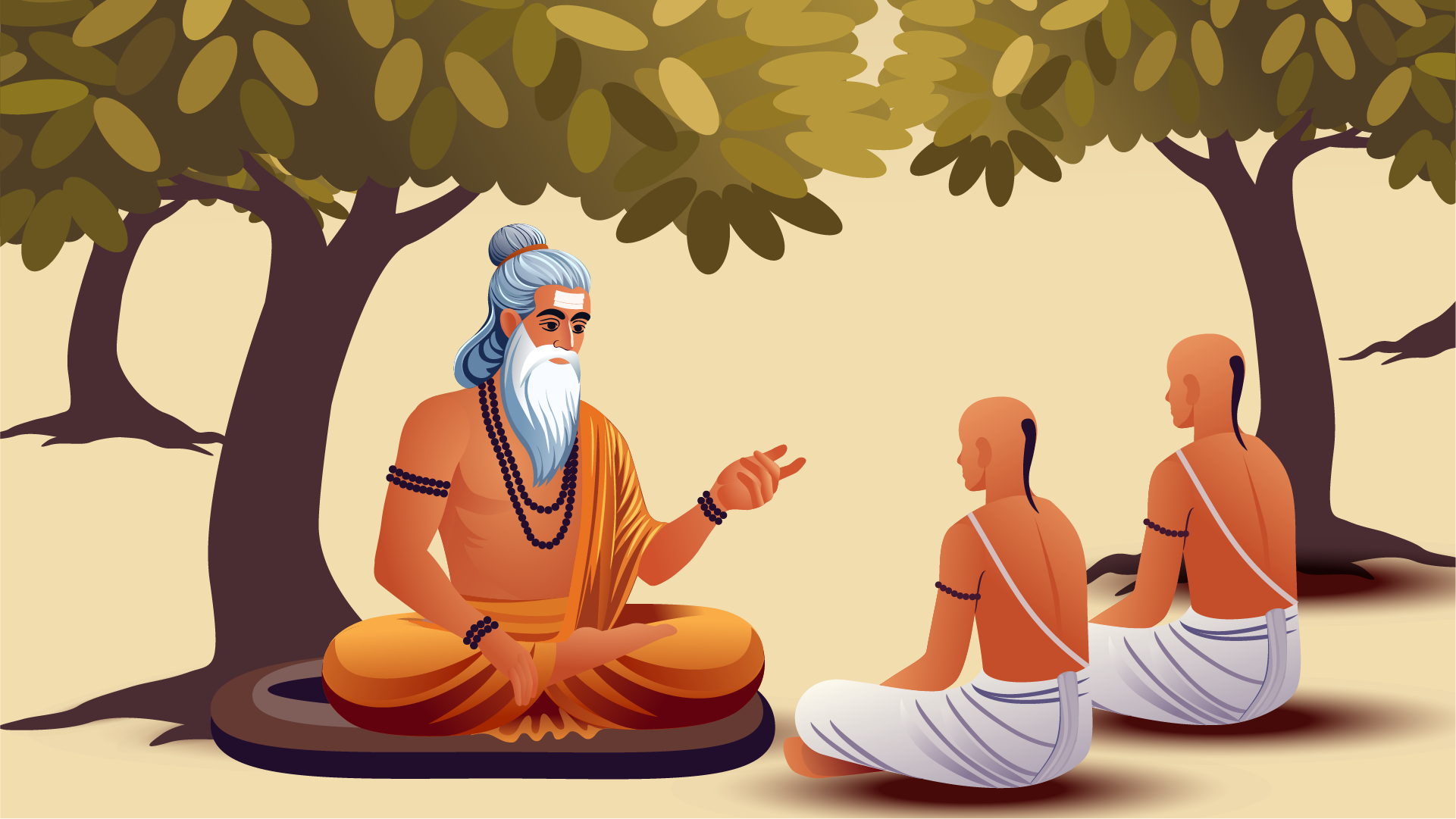
In the Upanishads, the Vedic corpus reaches its zenith and becomes its consummation. “Upanishad” is a Sanskrit word that literally means “to sit near,” and it refers to the practice of a pupil sitting close to a teacher in order to obtain esoteric knowledge. It includes discussion on metaphysics, ethics, and the development of one’s spiritual potential.
Core Teachings of the Upanishads
These three primary topics are investigated in the Upanishads:
- Brahman: The ultimate and limitless reality that lies behind the universe is known as Brahman.
- Atman: A person’s atman, or soul, is their most fundamental self or essence.
- Moksha: Liberation through the realization of the unity of Atman and Brahman is referred to as moksha.
The Chandogya Upanishad, for instance, is credited with delivering the well-known doctrine “Tat Tvam Asi” (That Thou Art), which asserts that the individual self is one with the reality of the collective universe. In a similar manner, the Katha Upanishad employs the metaphor of a chariot in order to describe the connection that exists between the body, mind, intellect, and individual soul.
The Upanishads set the stage for subsequent schools of Indian philosophy, such as Vedanta, and had a significant impact on the thought processes of philosophers such as Adi Shankaracharya. They also served as a source of inspiration for contemporary personalities such as Swami Vivekananda, who was responsible for bringing the wisdom of the Upanishads to the attention of the world. They also had an impact on Western thinkers such as Schopenhauer, who famously referred to the Upanishads as “the solace of my life.”
Final thoughts.
The Vedas’ intricate structure reveals the history of Indian spirituality and a universal journey of humanity, from ritualistic practices to philosophical inquiry, from fear of nature to realization of oneness. The Vedic corpus is a living tradition, continuously studied, recited, and interpreted, reflecting humanity’s search for meaning through outward rituals and inward realization, from the many to the one.