The Upanishads are a treasure hidden within the enormous treasure that is India’s spiritual tradition. The Upanishads go deeper, questioning things that resonate with humanity, such as
- Who am I?
- What exactly is the real nature of things?
- At the moment of death, what occurs?
- Is there something that persists forever and connects all of existence together?
These books represent the climax of the Vedas’ philosophical discourse. The transition from exterior rites to internal reflection, from the offering of sacrifices to the pursuit of knowledge, is symbolized by these objects. In addition, they serve as the basis for a significant portion of Hindu philosophy and have had an impact on thinkers all over the world.
This article explores the composition, themes, and structure of the Upanishads, highlighting their depth and universal appeal through specific examples.
What are the Upanishads?
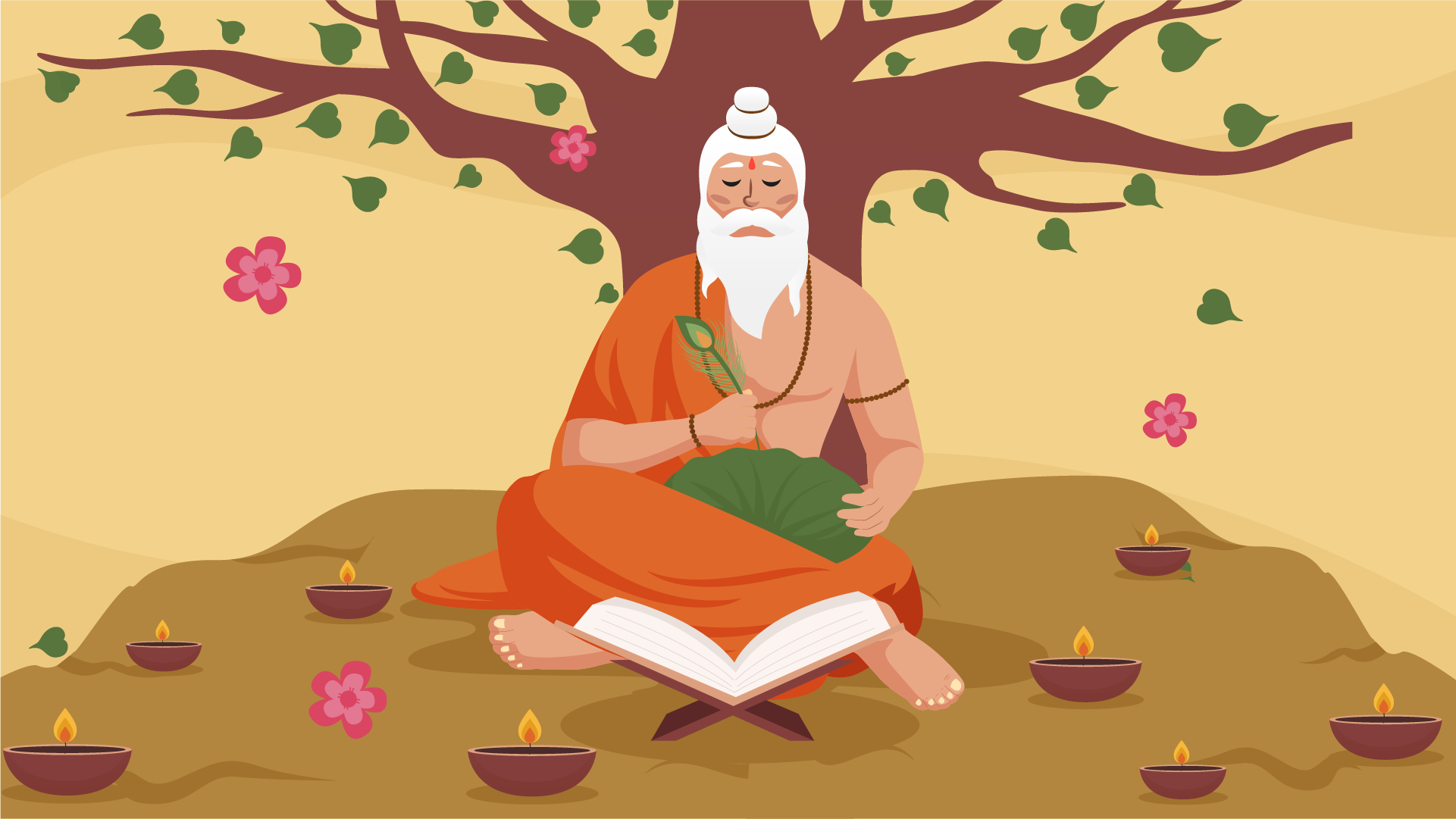
The name “Upanishad” is frequently translated as “sitting down near” (upa = near, ni = down, shad = to sit), which refers to the act of a learner sitting close to a teacher in order to gain spiritual wisdom. This describes the close-knit, oral tradition that was used to transmit these teachings to subsequent generations.
It is believed that there are more than 200 Upanishads; nevertheless, around twelve of the primary Upanishads are regarded as being the most significant and authoritative. These include the following:
- Brihadaranyaka Upanishad
- Chandogya Upanishad
- Taittiriya Upanishad
- Katha Upanishad
- Kena Upanishad
- Mundaka Upanishad
- Mandukya Upanishad
- Prashna Upanishad
- Aitareya Upanishad
- Isha Upanishad
- Shvetashvatara Upanishad
- Kaushitaki Upanishad
These are commonly referred to as the Mukhya Upanishads, which literally translates to “major Upanishads.” Since then, major philosophers such as Adi Shankaracharya have offered their thoughts on them.
Central themes of the Upanishads.
At their core, the Upanishads revolve around a few central themes, despite the fact that they cover a wide range of philosophical and mystical ideas ranging from the following:
1. Brahman: The Ultimate Reality
The reality that is defined as Brahman is said to be boundless, everlasting, and unchanging. It is also said to be the origin of everything. Brahman, in contrast to the particular gods that are worshipped in ritual songs, is beyond qualities and forms. That is the very core of everything that exists.
The Taittiriya Upanishad is the source of one of the most well-known pronouncements since it says:
“Satyam jñānam anantam brahma” literally translates to “Brahma is truth, knowledge, and infinity.”
2. Atman: The True Self
In the Upanishads, it is emphasized that the Atman, which is the most fundamental sense of self, exists beneath our ever-changing body and mind. Pure consciousness, unaffected by birth or death, is what we refer to as atman.
The assertion that Atman and Brahman are one and the same is a bold one made by the Upanishads. The expression of this identity is conveyed through the renowned Mahāvākyas, which are a collection of outstanding sayings.
- Chandogya Upanishad: “Tat tvam asi,” which translates to “That thou art.”
- The Brihadaranyaka Upanishad contains the phrase “Aham Brahmasmi” (I am Brahman).
Moksha, which means liberation
Realizing this unity of Atman and Brahman is the ultimate aim that must be accomplished. It is not via rituals or sacrifices that one attains liberation (moksha), but rather by the cultivation of knowledge, meditation, and self-realization.
It is common for the Upanishads to make assumptions concerning the beginnings of the universe. In contrast to theories that are based solely on material phenomena, these perspectives propose that the cosmos originates from Brahman and eventually dissolves back into it, much like waves that return to the ocean.
Examples from major Upanishads
1. Katha Upanishad: Dialogue with Death
The story of Nachiketa, a young boy who meets Yama, the god of death, is told in one of the Upanishads that is considered to be among the most lyrical. There are three significant questions that Nachiketa poses:
- At the moment of death, what occurs?
- Does the afterlife consist of something that is eternal?
- What steps can one take to achieve moksha, or liberation?
He learns from Yama that the Self, also known as the Atman, is irreversible and unaffected by death. In the same way that the body is shed much like worn-out clothing, the Self does not alter. This conversation lays the groundwork for the concept that immortality is not found in the body but rather in the realization of the everlasting Self.
2. Chandogya Upanishad: Tat Tvam Asi
Chandogya Upanishad includes the famous teachings that the wise man Uddalaka imparted to his son Shvetaketu. He explains to him that the same truth, which he refers to as Brahman, permeates everything in the universe, from the tiniest seed to the vastness of the cosmos. “Tat tvam asi” translates to “You are that,” and he says this while pointing to his son. This expression reflects the essence of the wisdom that is found in the Upanishadic tradition: the human soul is not distinct from the cosmic community.
3. Mundaka Upanishad: Two birds on a tree.
In this Upanishad, a symbolic narrative is presented in which two birds are seen perched on a tree. One of the birds consumes the fruits, which represents the human self since it is engaged in the delights of the world, while the other bird merely watches, which represents the greater self, which is undiscovered and eternal.
4. Mandukya Upanishad: The power of OM.
The Mandukya Upanishad, which is only twelve verses long, provides an explanation of the phrase OM (AUM) as the symbol of the entire cosmos. This is perhaps the smallest but most profound of all the Upanishads. The symbol “A” signifies awakeness, while “U” signifies a dream state, and “M” signifies profound sleep.
The method of teaching the Upanishads.
The Upanishads employ a variety of techniques, such as dialogues, parables, fables, and metaphors, in contrast to formal philosophical treatises. Instead of promoting orthodoxy, they stimulate inquiry and introspection among their audience. Teachers often use enigmatic and profound imagery to address students’ inquisitive questions, allowing them to reflect and explore their understanding.
The Upanishads have been rendered ageless via the use of this method of open inquiry, which has enabled them to be reinterpreted by generations of people from different cultures.
The Upanishads serve as a reminder that entering oneself is the most important trip. They inspire us to look for truth not in material items or rituals, but rather in being able to comprehend who we are as individuals. Their most important realization, which is that the individual and the universal are one, continues to be a revolutionary and game-changing concept even in the 21st century.
They symbolize a human quest that is shared by all people everywhere: the search for meaning, the fear of death, the yearning for freedom, and the need to comprehend our position in the universe.
Conclusion
These ancient Indian teachings, known as the Upanishads, are more than just ancient manuscripts; they are living wisdom traditions. Due to the fact that they place a strong focus on self-realization, the nature of reality, and the search for ultimate liberation, they serve as a philosophical shining example for all of humanity.