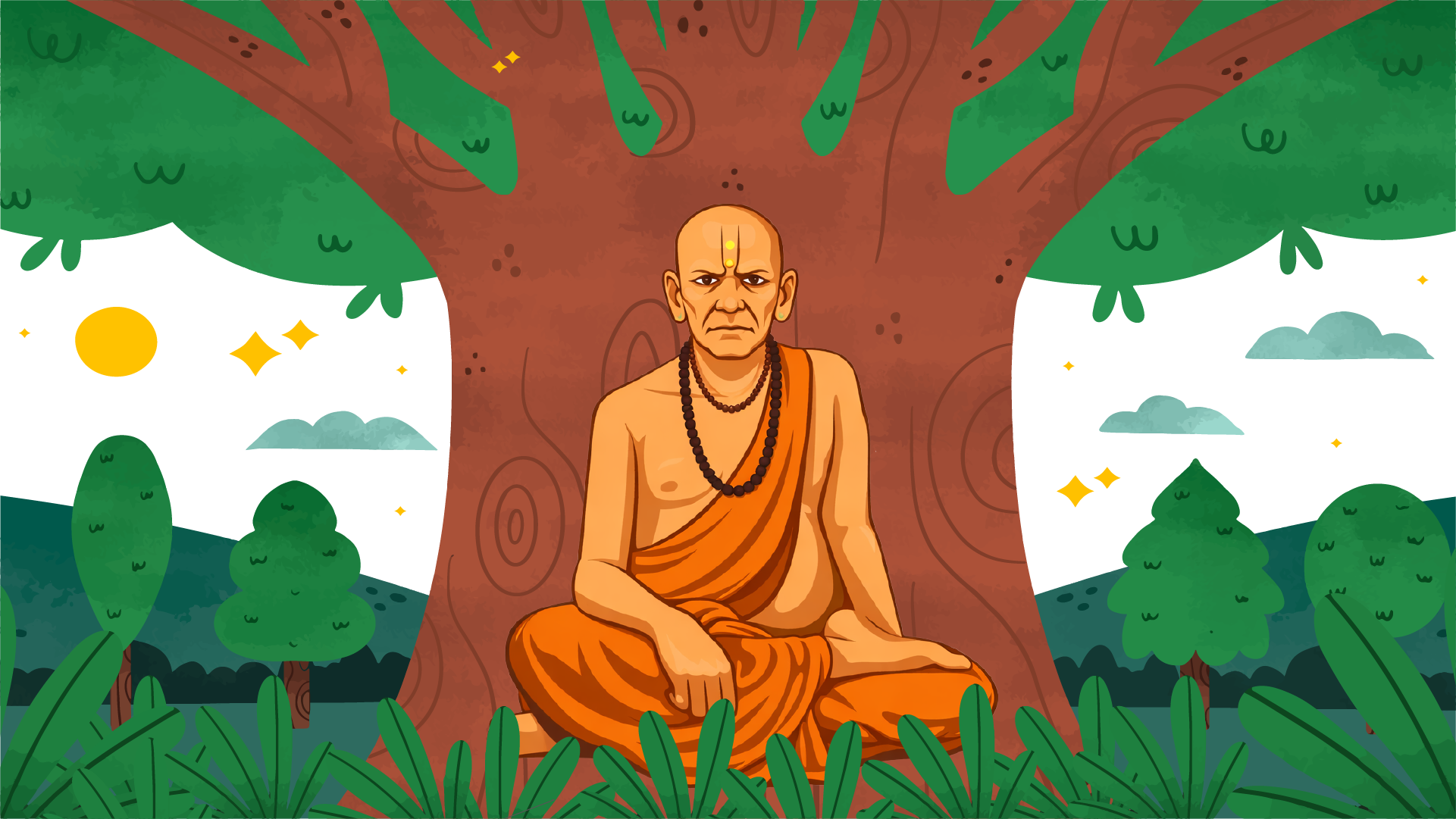
The guru-shishya parampara, or teacher-disciple lineage, is one of the oldest and most unique ways of learning in India’s long history of culture and civilization.
This tradition is not just a way to teach; it is a way of life that includes living, learning, mentoring, and moral development. The residential model of the gurukul is at the heart of it. This is an ashram, or hermitage, where a guru and his students lived together, and the line between learning from books and living was very thin.
The guru-shishya tradition, which integrates knowledge, devotion, discipline, service, and character formation, is crucial for contemporary audiences unfamiliar with Indian culture or classical education. Read about the significance of the guru-shishya parampara and how it shaped the knowledge transfer process in ancient India.
The Sanskrit word “guru” signifies a “heavy” or “venerable” figure who assists disciples in learning, attaining knowledge, and self-realization.
A shishya is a disciple or learner who follows a guru with humility, dedication, and a desire to learn in body, mind, and spirit.
Parampara refers to the continuous transmission of knowledge, often spiritual, philosophical, or technical, from one generation to the next through a teacher-to-disciple chain.
Therefore, the term “guru-shishya parampara” means a tradition of teacher-disciple relationships that includes instruction, mentorship, residency, character development, and experiential knowledge transmission.
The origins of guru-shishya parampara.
The guru–shishya tradition has its origins in the Vedic period of India, a time when formal educational institutions like universities, libraries, and printed texts were not yet established in their contemporary form.
The gurukul system began in the early Vedic era as a way for young “brahmacharis” (celibate students in the first stage of life) to live with their guru in a hermitage, away from their families.
Students could focus on their spiritual and intellectual growth at the gurukul because it was often in a forest or next to a river, away from the noise of town life.
The curriculum was very broad. The Vedas and other spiritual texts were at its center, but students also learned about logic, grammar, math, astronomy, ethics, warfare, government, and more.
How did learning happen in a Gurukul?
Students started their day early with baths, prayers, or meditation. They would help the guru with the daily tasks at the ashram, like gathering firewood, cleaning, cooking, and taking care of the lodgings. These chores weren’t extra; they were part of the learning.
They lived with the guru’s family (sometimes including the guru’s family or senior disciples), ate the same meals, and did the same things every day. There wasn’t much of a difference between school and real life.
The guru would watch the disciple’s skills, progress, and behavior and decide when they were ready to move on. Early education was primarily oral, involving listening (shruti), memorizing, reciting, talking, debating, and demonstrating, with writing becoming prevalent in later times.
The subjects were wide-ranging, including Vedas, Upanishads, grammar, logic (nyaya), metaphysics, astronomy, mathematics, statecraft (arthashastra), ethics (dharma), and, in some cases, warfare.
The guru’s relationship with the shishya extended beyond academics, serving as a mentor, moral compass, and spiritual role model, guiding the disciple in cultivating humility, self-discipline, and integrity.
Students often stayed for years, sometimes until early adulthood, initially in the brahmacharya phase, then progressed to more advanced studies and autonomous living.
Modern gurukul systems were non-commercial, with disciples giving gurus a “gurudakshina” as a sign of respect or service, usually at the end of their training. The focus was on service, devotion, and acknowledging the debt owed to the guru, rather than a fee-for-service model.
The tradition in literature and epics.
The guru-shishya paradigm is deeply ingrained in Indian epics and classical literature, underscoring its cultural significance. For example, Lord Rama, Lakshmana, Bharata, and Shatrughna are said to have studied with the sage Vasishtha (and later with Sage Vishvamitra) in the epic Ramayana. They learned not only how to use weapons but also how to run their lives and do their duties.
In the epic Mahabharata, the Kaurava and Pandava princes study archery, ethics, and diplomacy with their teacher Dronacharya. The tale of Ekalavya, who, despite being prohibited from attending the gurukul, trains with a clay idol of Dronacharya and subsequently presents his thumb as gurudakshina, serves as a profound emblem of devotion and the guru-shishya relationship.
The idea of lineage (parampara) is still very important in classical arts (like music and dance) and monastic traditions. A student identifies not only with the guru but also with the guru’s guru, and so on.
These stories have both legendary and educational purposes. They show how important the guru-disciple relationship is, how important learning is, and how important it is to pass on cultural, moral, artistic, and spiritual knowledge from one generation to the next.
The system’s journey from Gurukul to universities.
The gurukul model and the guru-shishya tradition changed over time; they grew, adapted, and sometimes mixed with other types of institutions to become larger ones.
Takshashila (Taxila), in what is now Pakistan, was one of the first places in the Indian subcontinent to offer higher education. From about the 6th century BCE, it drew students from Persia, Central Asia, and Greece. It included living with a teacher, a wide range of subjects, residential life, and mentoring.
Nalanda University in eastern India (5th century CE onward) was another important center. Students lived in dormitories or viharas, studied with older teachers, debated, served, and lived in community. Other schools, like Vikramashila, Valabhi University, and Odantapuri, also kept the idea of a residential teacher-disciple going.
Changes in society and structure
As Indian society changed over time (with kingdoms, empires, trade, the spread of Buddhism, Jainism, and later Islam and colonialism), the subjects that were taught also changed. Logic, linguistics (Panini’s grammar), medicine (Ayurveda), astronomy, and statecraft were added to the traditional Vedic texts.
In classical arts, including dance, music, drama, martial arts, and crafts, the guru-shishya model persisted as a fundamental pedagogical approach, particularly in response to institutionalized education systems. In Indian classical music, for instance, lineage (parampara) is still a very important idea.
During the colonial period, Western schooling models, textbooks, tests, and formalized certification were introduced. This changed the way education worked in the subcontinent and made traditional residential gurukuls less common.
In short, the guru-shishya parampara in its classic Vedic-gurukul form may not be the most common way to learn anymore, but its ideas and methods live on in many other ways.
What is the importance of Guru-Shishya Parampara today?
Why should people today care about a way of learning that may have reached its peak hundreds of years ago? There are a few reasons.
The guru-shishya system focused on developing the whole person, including their intelligence, character, morals, discipline, social contribution, and ability to ask questions about themselves. This is different from most modern education, which is mostly about passing tests, getting credentials, and teaching subjects in separate groups.
In a gurukul, the lines between learning and living were blurred. Chores, service, community life, study, and reflection were all part of the same experience. This model encourages thinking beyond simple knowledge transfer and considering learning that is immersive, experience-based, and full of stories.
The parampara model emphasizes continuity in teaching values, allowing students to become part of a lineage, carry on teachings, and eventually become teachers, a different approach to legacy and responsibility in a short-lived world.
The old model’s principles, including mentoring-based coaching, group living, service learning, and ethics, continue to influence modern teaching methods, corporate training, creative mentoring, and holistic workshops.
What were a few shortcomings of the ancient guru-shishya parampara?
The traditional guru-shishya system had a structured social structure with hierarchy, varna, gender roles, and residential celibacy, which are often overlooked in mainstream narratives.
In ancient India, students experienced different levels of access to education. While ideals emphasized equality, various factors such as economic status, caste, gender, and geography did have an impact.
Modern education systems have grown so large that it’s challenging to maintain the personal touch of one-on-one mentoring in a residential setting. This suggests that applying it directly to today’s mass schooling isn’t straightforward.
The tradition often promoted “hard discipline” or “sacrifice” in ways that may not align with contemporary views on student rights, autonomy, and welfare.