On the sixth day of Navratri, people worship Goddess Katyayani, a fierce and powerful form of Adi Shakti who is known as the slayer of the powerful demon Mahishasura. Her story is a big part of Hindu mythology and can be found in old texts like the Vamana Purana, Devi Mahatmya (part of the Markandeya Purana), the Skanda Purana, and the Devi Bhagavata Purana.
The day honors her martial skills and divine strength, as well as the symbols of courage, protection, and righteousness that show how important she is to the cosmic order.
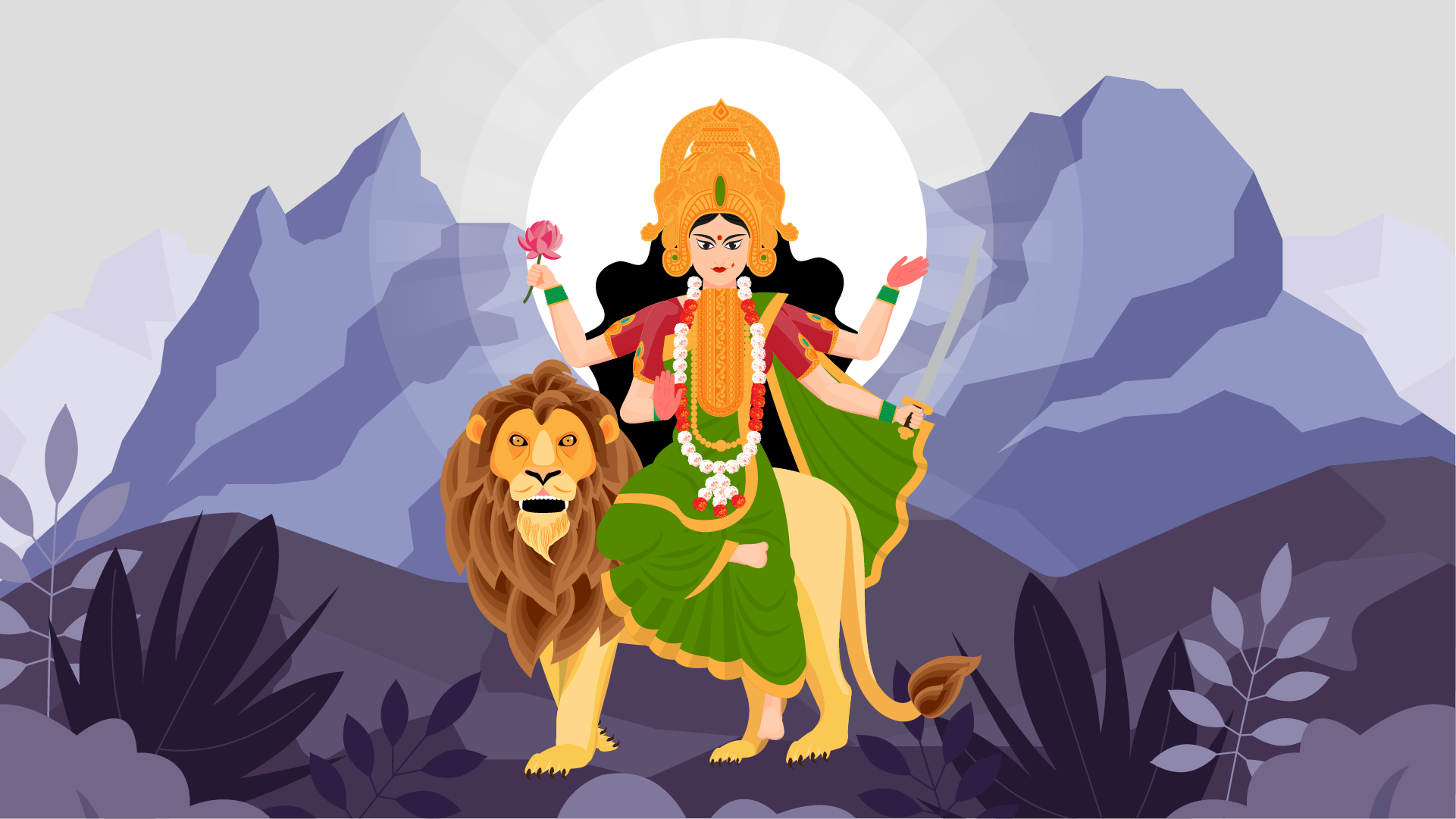
The way Katyayani is described in religious texts is full of symbolic meaning. The eighteen hands holding different weapons show how powerful and widespread the goddess is in protecting and destroying as needed. The third eye and her fierce look show that she has spiritual insight and the power to get rid of ignorance.
Her lion mount stands for bravery and being a leader. Red is the main color in her pictures, and it stands for both the energy of life and strong passion. In Yogic and Tantric philosophy, the goddess is linked to the Ajna Chakra (third eye chakra), which is in charge of wisdom, perception, and inner awakening.
The birth of Katyayani: A creation by God.
Katyayani’s story of how she came to be is one of a kind and very exciting. The gods couldn’t beat the demon Mahishasura, who was so cruel that he threw the three worlds into chaos.
So they worked together in a cosmic way to combine their divine powers. The Vamana Purana and the Kalika Purana say that the gods sent out beams of rage and energy with the goal of making a goddess strong enough to defeat the demon.
This concentrated energy crystallized in the hermitage of the sage Katyayana, whose name the goddess bequeaths; thus, she is called Katyayani—”the daughter of Katyayana.”
As told in the Devi Mahatmya and the Vamana Purana, Katyayani looked like a thousand suns, with three eyes, black hair, and eighteen arms. Each arm held a weapon given to her by a different god.
Shiva gave her his trident, Vishnu gave her a Sudarshana chakra (discus), Varuna gave her a conch shell, Agni gave her a dart, Vayu gave her a bow, Surya gave her a quiver full of arrows, Indra gave her a thunderbolt, Kubera gave her a mace, Brahma gave her a rosary and water pot, Kala gave her a shield and sword, Visvakarma gave her a battle-axe, and many more.
With this powerful weaponry, Katyayani got on the lion, which stood for bravery and power over evil.
The fight against Mahishasur.
The Devi Mahatmya and other Puranas tell the story of the great fight between Katyayani and Mahishasura in great detail. Mahishasura was born to the demon Rambha and a buffalo woman named Mahishi.
He could change between his buffalo and demon forms whenever he wanted. His reign of terror was full of chaos and pain, and even the gods themselves were forced to obey him.
When Mahishasura’s army attacked the heavens and beat Indra and other gods, the gods were so desperate that they made Katyayani. After she showed up, she went to the Vindhya Mountains, where Mahishasura lived.
The fierce battle that followed reached its peak when she successfully beheaded the buffalo demon, ending his reign of terror and bringing peace back to the universe.
She was given the name Mahishasuramardini, which means “the slayer of Mahishasura,” after she killed him. Her victory is a sign of the triumph of good over evil and the divine feminine’s unique ability to destroy darkness.
Worship and celebration on day six of the Navratri festival.
In the order of Navratri, Katyayani’s day stands for the strength that comes from discipline and the energy needed to get through tough times. The first five days focus on purity, penance, and awakening. The sixth day, on the other hand, tells devotees to embody active strength, moral clarity, and a fearless commitment to the truth.
Katyayani Vrata is a set of rituals and vows that devotees, especially unmarried women, use to pray for a happy marriage. People also ask for her blessings to help them get through tough times, get rid of obstacles, and be successful in their personal and professional lives. It is customary to honor the goddess’s power with red flowers, clothes, and sweets.
References from ancient Indian texts.
The Devi Mahatmya, which is part of the Markandeya Purana, has the most detailed story about Katyayani. In it, she is the fierce form of Durga that the gods made to destroy evil. The Vamana Purana also tells the story of how she was made and what gifts she got from the gods. The Kalika Purana sees her as a powerful warrior goddess and puts her worship in the tantric tradition.
The Skanda Purana and Devi Bhagavata Purana are two other texts that talk about her important role as Durga’s aspect and her cosmic mission to bring back dharma.
Katyayani says that you need to have both courage and power, as well as compassion and righteousness. Her story is a timeless reminder that darkness, whether it’s inside or outside of us, can’t beat strength that comes from purpose and God’s will.
Worshiping her during Navratri encourages the seeker to become their own warrior, to face life’s challenges without fear, and to do what is best for everyone.