
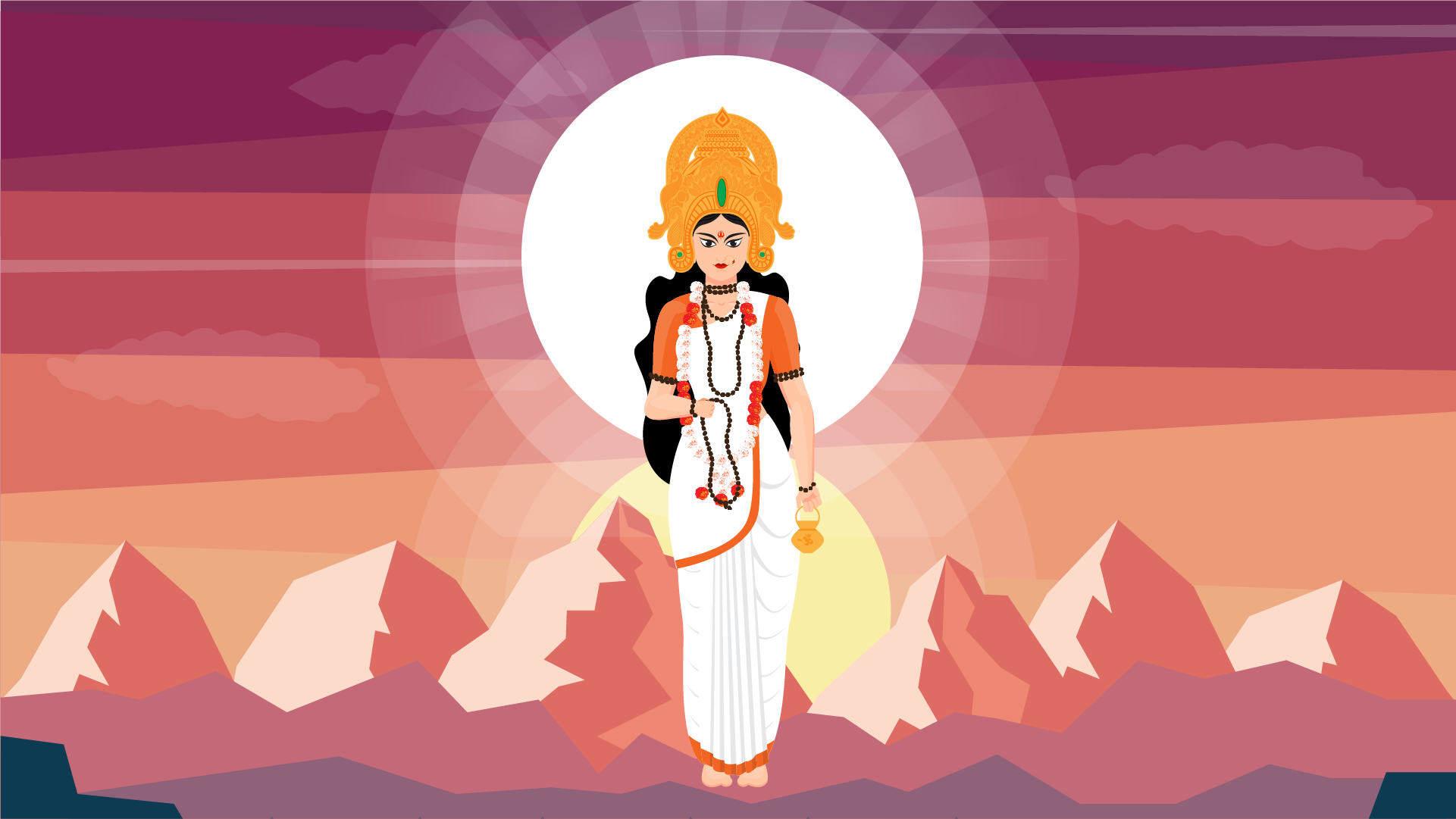
We honor Goddess Brahmacharini on the second day of Navratri. She is a form of Parvati who stands for deep devotion, penance, and spiritual strength. Her story, which is based on old texts and poetic interpretations, teaches us important lessons about how to be strong, stay focused, and how powerful belief can be in changing our lives.
The most beautiful stories about her are in the Skanda Purana and the Shiva Purana. The Devi Mahatmya (700th verse of the Markandeya Purana) talks about her appearance. It says she is a bright, peaceful goddess who walks around barefoot and in white, with a prayer mala (rosary) in her right hand and a “Kamandal” (water vessel) in her left. People say she shines with purity and strength from within.
The Devi Mahatmya and the Kalika Purana both tell the stories of Navratri. Each day of the festival honors a different part of the goddess’s journey to becoming one with the Divine and realizing her true self. Followers are told to focus on themselves, learn as much as they can, and be patient and strong through all hardships on the second day, which is dedicated to Brahmacharini.
The origin of Goddess Brahmacharini.
The story of Brahmacharini is a lovely continuation of Devi Sati’s eternal love. After Sati killed herself in the sacrificial fire because her father, Daksha, disrespected Shiva, she was reborn as Parvati, the beloved daughter of King Himavan and Queen Mainavati.
Many people thought that this holy renewal would fix the worlds and bring peace back to the universe. Shiva and Parvati had to get together for Shiva’s son to be born. This son was meant to defeat the demon Tarakasura. This brought Shakti and Shiva back together.
Parvati felt a deep connection to the ascetic Shiva from a young age, like a whisper from her past life. Her spiritual guides and wise sages comforted her and told her that this was her true path, which made her feel more determined to follow it.
Sage Narada, the cosmic traveler and son of Brahma, told young Parvati the story of her fate and how much devotion it would take to accept it. The Vedas say that “tapasya,” or penance, is the most important way to follow a religion.
Parvati really wanted to go down this path and become a Brahmacharini, which means “she who follows the discipline of Brahma.”
The way of penance.
The Puranic traditions beautifully show Brahmacharini’s dedication. You can see this in different versions of the Shiva Purana, Skanda Purana, and Markandeya Purana.
In Sanskrit, the word “Brahmacharini” means a woman who gives up everything to search for Brahman through a life of wisdom and asceticism. In these texts, Parvati’s disciplined practices show that she has a strong sense of self-denial, unwavering dedication, and a strong spiritual longing.
For a long time, Parvati lived in the mountains and jungles. She only ate fruits and beets for the first thousand years. For the next hundred years, she only ate greens. For hundreds of years after that, she only ate bilva leaves and the clean water from holy rivers.
She finally stopped eating even these small meals. The Skanda Purana does a great job of showing how dedicated she was to the vow of Aparna, which means not even eating fallen leaves. In Vedic tradition, Aparna is like the most respected rishis and seekers.
Even when it was very hot, very windy, or very rainy, she was strong through all of her problems. The only safe place for her was on the ground in the forest.
The ancient Vedic hymns that praise self-discipline as a way to reach spiritual understanding (Rigveda 10.109, Atharvaveda 11.5) sound like every step of her ascetic path. As Parvati’s devotion grew, it is said that a bright light filled her and caught the attention of both gods and wise teachers.
The divine test.
The gods wanted Shiva and Parvati to get married right away because Tarakasura was a threat. They asked Kamadeva, the god of love, for help. He shot Shiva with an arrow of desire to wake him up from his meditation. Shiva opened his third eye and burned Kamadeva in response. This made Kamadeva more detached and Parvati even more determined to do more penance without expecting anything or complaining.
Parvati didn’t give up, even though she was sad. She was still determined. The asura Prakandasura attacked her while she was meditating, which was her last and hardest punishment. He did this because she was weak.
The goddesses Lakshmi and Saraswati came to help, but it was Parvati’s kamandalu, a simple water pot that stood for an ascetic, that turned the tide and let loose a flood that wiped out the demon’s armies. This is what the Shiva Purana and the Devi Bhagavata Purana say. When Prakandasura tried to attack, Parvati’s inner fire turned into flames that burned him up as soon as she opened her eyes.
Shiva’s test and the proof of tapasya (penance).
The Shiva Purana and other Puranic texts say that Shiva did not move when Parvati did her penance. He did this to see how much she cared. Shiva came to Parvati as a wandering ascetic and made fun of his own body while asking her if she was crazy for what she was doing.
Parvati answered every question, talked about her love for Shiva in a philosophical way, and promised to always be loyal to him, even when things got hard or people made fun of her.
This is called Brahmacharya, and it means that she was very spiritually disciplined and clear. It not only showed the highest ideals of the Upanishads (Chandogya Upanishad 8.5.1, Manusmriti 2.220), but it also made her a perfect example of how to always look for the highest, the Absolute.
Shiva finally showed Parvati his true form, blessed her, and married her.
The gods knew this holy union would happen and made it happen. It put the universe back in order and made it possible for Kartikeya to be born, the long-awaited son who would free the worlds from Tarakasura’s fear.
Last thoughts.
Brahmacharini’s story, which comes from the Vedas, Upanishads, and Puranas, stresses the importance of waking up one’s Brahmacharini within and the eternal path of persistence.
Her asceticism and kamandalu teach humility, and her mala gives her strength and a deep connection to God. On Navratri, people bring flowers to her feet and promise to face the challenges of life with strength and calmness.
The Markandeya Purana says that those who follow truth and austerity are rewarded by all realms because they become Brahmacharini, the seeker of Brahman. Her story still inspires and guides millions, giving them wisdom, discipline, and a steady light.
But wait, what happened to Kamdeva, who died for the sake of the gods?
Shiva opened his third eye and burned Kamadeva to death after Kamadeva shot arrows of desire at him to wake him up from his deep meditation and get him to marry Parvati. The gods asked Kamadeva for help because they knew that only Shiva’s son could defeat the demon Tarakasura.
But because Shiva was in such a deep state of meditation, love couldn’t reach him. Shiva turned Kamadeva to ashes in a fit of rage, which made his wife, Rati, very sad. Therefore, Shiva gave Kamadeva a new life without a body, making him “Ananga,” the one without a body. He could still touch love and desire in the universe as a hidden presence.
Eventually, Kamadeva was born again as Pradyumna, Krishna and Rukmini’s beloved son. He made his way back to Rati, who had changed into Mayavati. Together, they accepted their divine purpose in this new part of their lives.
Now, that sounds like a story with a happy ending.

Leave a Reply