In India, this is the time when people gather for nine nights of spiritual connection to honor Goddess Shailaputri, the first of Durga’s nine holy forms.
The name “Shailaputri” translates to “daughter of the majestic snow mountains.”
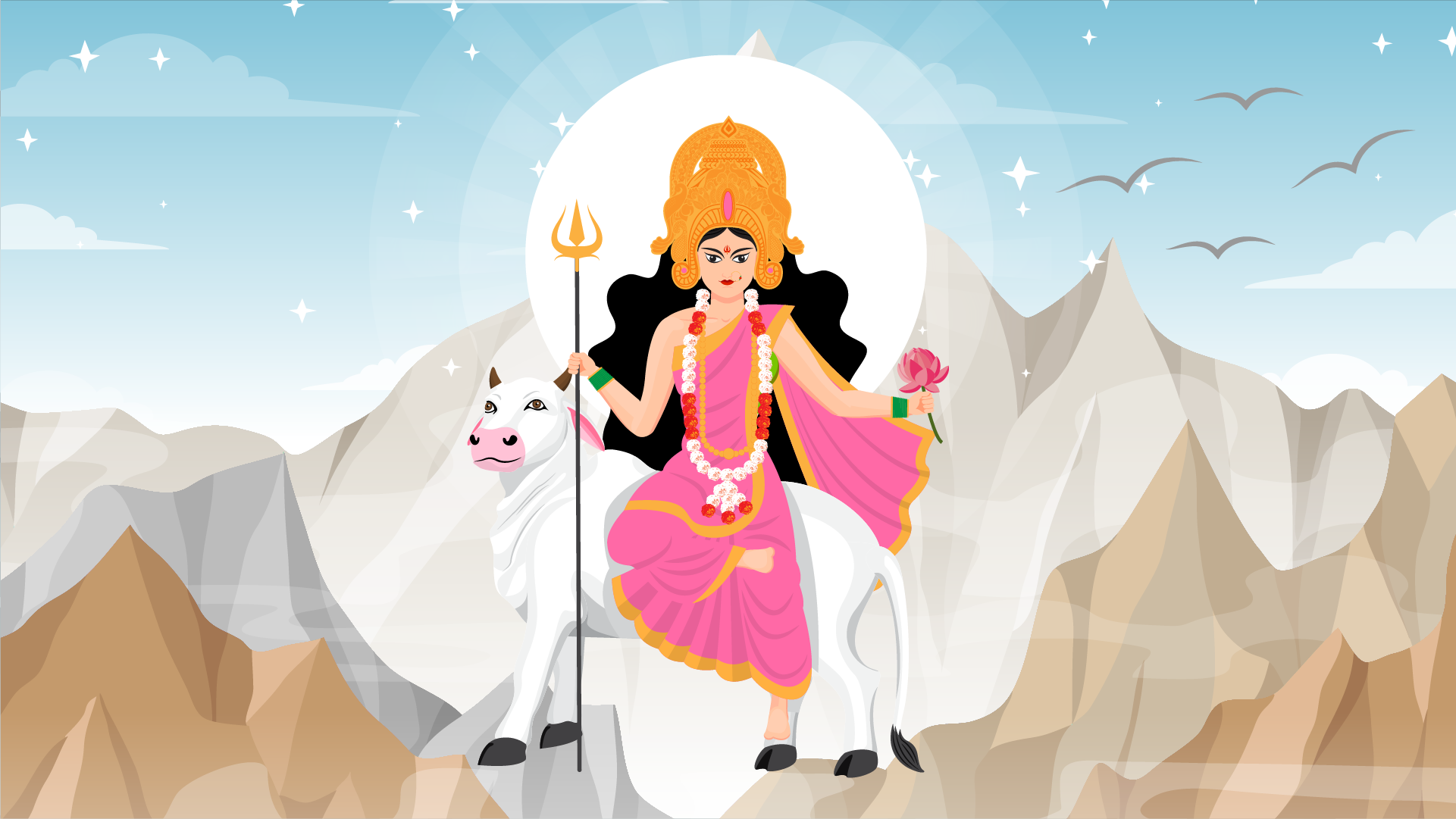
Goddess Shailaputri is often depicted with a crescent moon on her forehead, representing the infinite essence of consciousness. She is considered as the symbol of spiritual awakening. The trident, or Trishul, symbolizes her profound understanding of the three gunas, nature’s attributes, and time dimensions. The lotus flower in her left hand represents spiritual awakening and devotion, while Nandi the bull represents righteousness and strong determination.
On the first day of Navratri, we honor not only a goddess but also spiritual growth and an endless cycle of divine love. Her journey is one of sacrifice, renewal, and a deep commitment to humanity and divinity.
The divine story of Goddess Shailaputri according to ancient Indian texts.
The Shiva Purana and Devi Bhagavatam provide captivating and intricate stories about Shailaputri’s divine origins.
The Markandeya Purana, which features the cherished Devi Mahatmya, also known as the Durga Saptashati, shares a narrative that beautifully unfolds the divine forms throughout the cosmic cycle.
The ancient scriptures, especially the Sati Khanda of the Shiva Purana, tell the story of how the goddess first graced the earth as Sati, emerging from the very essence of cosmic consciousness.
The texts portray her birth not just as a mythological tale but as an essential cosmic event that would ultimately bring harmony back to the universe.
The story of Sati: A journey of love and sacrifice.
There was a wise king named Daksha Prajapati who lived in a time when gods and humans lived together, and the universe needed their help. He was one of Lord Brahma’s favorite sons.
Sati was one of Daksha’s many daughters, but she stood out because of how devoted she was to spiritual pursuits. From a young age, Sati’s heart was fully devoted to Lord Shiva, the esteemed ascetic who meditated on Mount Kailash.
The tales within the Shiva Purana reveal her profound devotion, as she undertook deep penance, not seeking worldly gains, but for the sacred blessing of being Shiva’s eternal companion.
King Daksha was against it because he thought that Shiva, who was covered in ash and had snakes on him, was not a good match for his daughter.
However, Sati and Shiva came together in a sacred marriage, symbolizing the timeless bond between Shakti, the divine feminine energy, and Shiva, the divine masculine consciousness.
The Daksha Yagna: A father’s joy and its heartbreaking aftermath.
Time moved slowly, but Daksha’s hurt pride led to a terrible mistake that would shake the very roots of the world. There is a story in the Vayu Purana, the Kurma Purana, and the Shiva Purana about the Daksha Yagna. It was a big sacrifice event that ended with a cosmic disaster.
All the gods, sages, and celestial beings were invited to Daksha’s big Brihaspati Yajna, but he decided to leave out his own daughter Sati and her husband Shiva. This deliberate slight wasn’t just a personal offense; it felt like a deeper breach because Shiva is a central figure of divine awareness.
Sati felt a heavy weight in her heart when she learned about the big event. She had a deep love for her family, yet her dedication to her husband was equally strong. The scriptures reveal her inner turmoil: Shiva advised her against going to a place where she wasn’t welcome, yet her deep connection with her parents led her to disregard societal expectations and her husband’s desires.
The profound sacrifice of Sati’s self-immolation.
When Sati arrived at her father’s ceremony, she was greeted not with the warmth and honor a daughter deserves, but with intentional humiliation.
Daksha publicly humiliated Shiva in front of the gathered guests, deeming him unworthy and disparaging Sati for her decision to marry him. The Daksha Yagna section of the Shiva Purana tells the story of Sati, whose deep sorrow and anger grew as she saw the disrespect directed towards her beloved.
Carrying the burden of the shame that had fallen on Shiva, Sati chose to self-immolate in the sacred fire. Loosing Sati was a significant moment in the grand scheme of bringing harmony back to the universe.
The fury of Shiva and the unraveling of the universe’s harmony.
When Shiva learned of Sati’s death in his serene mountain home, his sorrow translated into an intense anger that seemed to endanger all of existence. With great anger Shiva took a lock of his tangled hair and brought forth Virabhadra and Bhadrakali, fierce warriors meant to put an end to Daksha’s ceremony.
Veerabhadra, a formidable warrior with multiple arms, symbolizes divine wrath and retribution. Bhadrakali, a dark-skinned goddess with multiple arms, is a protector and destroyer of evil. They represent the balance of power, illustrating how divine power maintains cosmic balance. Their actions symbolize the destruction of pride and ego, restoring harmony and order.
The devastation was total and heartbreaking. The Vayu Purana shares vivid accounts of how the Bhutaganas, Shiva’s army, disrupted the ceremony by overcoming gods and wounding celestial beings. It is believed that Veerabhadra destroyed Daksha Prajapati’s yagna by decapitating his head.
It was only with the help of Brahma and Vishnu that cosmic order was finally brought back, and Daksha was brought back to life with a goat’s head as a reminder of his pride.
The sacred renewal from Sati to Shailaputri.
Even though cosmic justice was done, Sati had to come back for a greater reason. This reincarnation was a part of a larger scheme, not only a chance. To maintain balance, the universe itself required the union of Shiva and Shakti.
She entered the world as the cherished daughter of Himavan, the majestic ruler of the Himalayas, and his beloved queen, Mainavati. Devi Bhagavatam reveals her birth was marked by heavenly signs, suggesting she was Adi Shakti’s return. Shailaputri was known by various names, including Shailaputri, Parvati, Hemavati, and Bhavani.
A journey of the soul: Reflection and sacred acknowledgment.
Even in her new form, her divine purpose stayed the same. The Shiva Purana tells us about Parvati, who became known as Shailaputri. She felt a deep and undeniable pull towards spiritual pursuits, which ultimately led her to Shiva.
The scriptures reveal her profound dedication, as she gave up all the luxuries of royalty to choose a simple life in the forest, illustrating that genuine love from the divine transcends any material circumstances. Shiva, witnessing his cherished consort in her changed form, ultimately welcomed her steadfast devotion with open arms.
Their reunion was a moment that restored a sense of harmony to the universe. Shakti reunited with her everlasting companion, allowing the journey of creation, preservation, and transformation to carry on its course.
Final thoughts.
Shailaputri’s story demonstrates the transcendence of divine love and devotion, transcending earthly boundaries and even death. Her journey from Sati to Shailaputri demonstrates the resilience of spiritual connections, evolving and reemerging in new ways. Her worship on Navratri day serves as a reminder of the importance of steadfast devotion and strong spiritual determination.