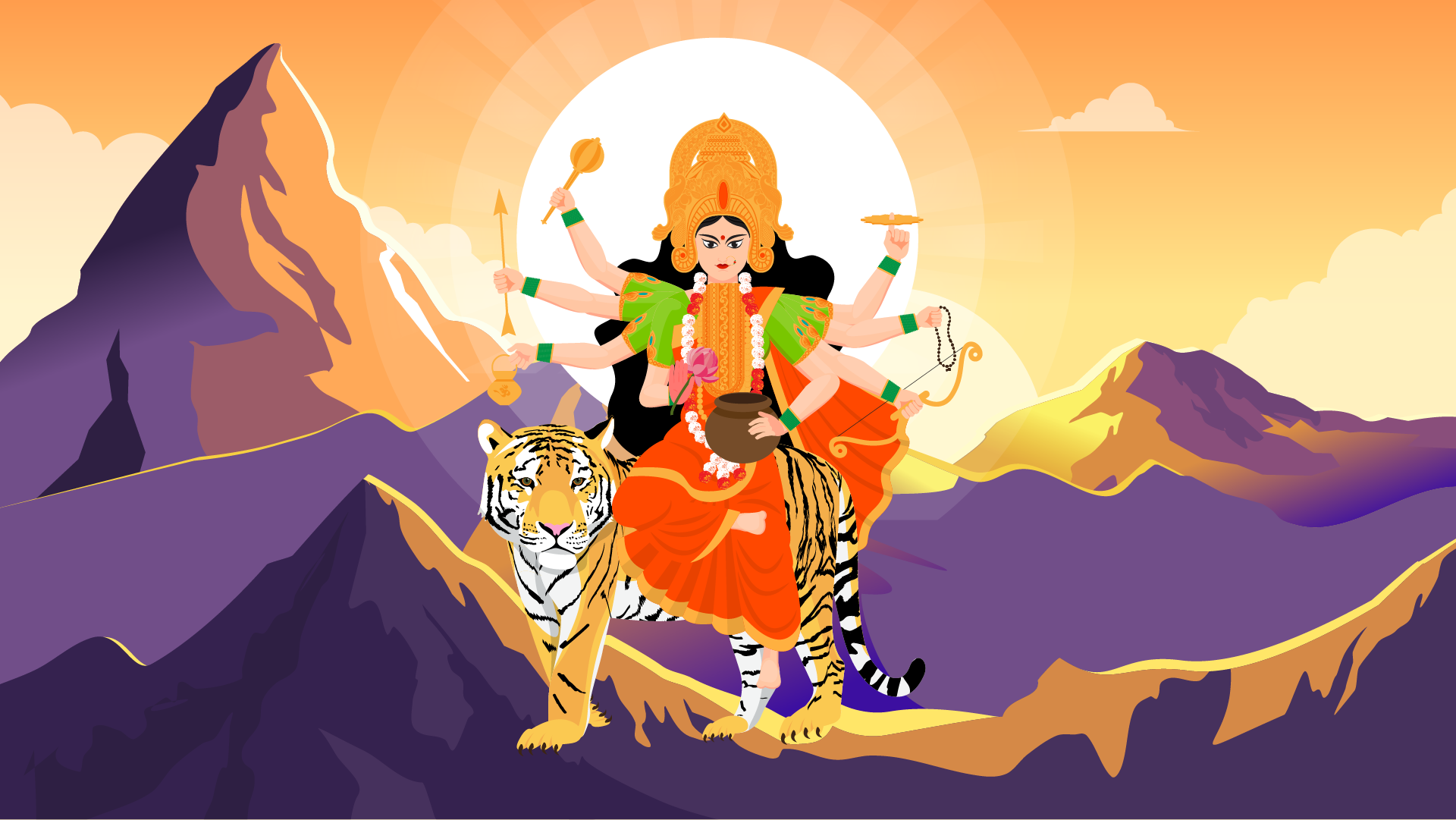
The fourth day of Navratri is for Goddess Kushmanda, who is said to have created the universe with her divine smile. Kushmanda is the cosmic energy that starts life and fills the void with light. Her name and stories have deep meanings and come from old texts like the Devi Mahatmya, the Markandeya Purana, and other Vedic texts that talk about creation, energy, and divine motherhood.
The Vedas say that the universe started out as a dark, empty space, a cosmic egg, or Brahmanda, and that divine energy, or Shakti, brought it into being.
The Devi Mahatmya, an ancient Hindu text that is part of the Markandeya Purana, says that Kushmanda is the fourth avatar of Goddess Durga and the first creative energy that appeared when there was only darkness and emptiness.
Her name itself breaks down into “Ku” (little), “Ushma” (warmth or energy), and “Anda” (cosmic egg), meaning she created the cosmic egg with the “little warmth” of her smile.
Her bright smile was the first light in the universe, and it started the process of creating galaxies, stars, planets, and all living things. This cosmic smile stands for the first burst of energy that turned nothingness into the universe we see today.
Kushmanda, believed to reside at the center of the Sun, provides vital energy to the Sun, ensuring its survival and maintaining cosmic balance.
The Rigveda and Yajurveda, two Vedic hymns, talk about the cosmic egg (Hiranyagarbha) as the source of creation, which is in line with Kushmanda’s role. In a philosophical sense, she is the cosmic heart chakra (Anahata), which stands for love, life, and the energy that keeps the universe going.
What is Hiranyagarbha?
Hiranyagarbha (golden womb/egg) is the name of the cosmic egg from which the universe came into being in the Rig Veda. It is also the name of the creator god Brahma.
The Hiranyagarbha Sukta of the Rig Veda talks about this golden egg that floats in the waters of the beginning of time and then breaks open to make the universe, starting the cycle of creation, preservation, and destruction.
The Devi Mahatmya (Markandeya Purana), the Rigveda’s cosmic hymns, and Puranic stories about Surya and the cosmic cycle all mention Kushmanda. This connects Kushmanda directly to the story of the creation of the universe in Hindu theology and scripture.
The story of Goddess Kushmanda to establish the cosmic order.
In the vastness of the Vedic cosmos, creation is an endless cycle of energy that keeps coming into being. The start of this never-ending cycle is when Kushmanda appears.
The Rigveda and Yajurveda talk about the primal energy (Shakti) that keeps the universe in order. Kushmanda is a goddess who represents this creative force. She is the life force that gives Lord Surya, the Sun God, life and energy.
According to legend, after the demon Jatukasura was defeated, two other demons, Mali and Sumali, did tapasya (penance) to get more power, which upset the balance of the universe.
The Sun left its place to face them, but this caused the universe to be dark and destructive. Shiva hit the Sun with his trident because he was angry about the chaos. This made the Sun pass out, and the universe went dark.
Parvati took the form of Kushmanda to bring back order. She put a sphere of fire and light in the Sun’s place, bringing life back to the cosmos. This story, which is found in Puranic texts, shows that Kushmanda is not only the creator but also the one who brings balance back to the universe.
The story of Mali and Sumali
The Uttara Ramayana and Srimad Bhagavatam are two Hindu texts that talk a lot about Mali and Sumali, who are Rakshasa (demon) brothers. Along with their brother Malyavan, they were strong demons who did harsh austerities to get boons from Brahma, which made them stronger and live longer. These demons ruled Lanka and were known for being very good at fighting and not being afraid of the gods.
The Srimad Bhagavatam (6.10.19–22) says that these evil rulers gave the devas (gods) a lot of trouble and fought hard against King Indra’s army. Even though they were strong, Vishnu beat them by cutting off the heads of Mali and Sumali with his divine discus (Sudarshana Chakra).
When their brothers died, Sumali and the other demons ran away to the netherworld, leaving Lanka empty. Vishnu then named Kubera the new king of Lanka to bring back order and wealth.
The Ramayana and other epics also say that Sumali is the grandfather of Ravana, the demon king of Lanka. He was a famous warrior who fought against divine forces but was ultimately defeated by Vishnu and his avatars. He was the father of many demons. The Puranic texts show that both Mali and Sumali were important members of a family of powerful demons who fought against the cosmic order and were defeated to bring back dharma.
The stories of Jatakasur, Mali, and Sumali are all about cosmic conflict. They are found in the Puranas, the Ramayana, and the Bhagavatam. They show the eternal battle between divine order and demonic chaos. Jatakasur is an immediate threat that was stopped by the power of the divine feminine (Parvati as Chandraghanta), while Mali and Sumali are demonic forces that Vishnu stopped to keep the balance of the universe.
References to symbols and scripture.
Kushmanda’s representation of the cosmic egg “anda” is linked to the primordial Purusha Sukta in the Rigveda, which describes how the cosmic man creates everything. Her warmth, “ushma,” and “ku” mean the small amount of energy needed to start creation. Her smile was the spark that turned nothingness into real worlds.
The Devi Mahatmya, which is part of the Markandeya Purana, talks about Kushmanda in great detail. It says that she is a shining goddess with eight arms holding weapons and symbols and that she gives her followers health, wealth, and strength. According to yogic texts and tantric philosophy, she embodies Anahata Chakra (heart chakra), which stands for love, compassion, and life.
In the Puranas, she is also called the cosmic mother, and she is the source of all creative energies, giving all living things health and wealth. The Lakshmi Tantra and other Tantric texts talk about the goddess in ways that are similar to Kushmanda, focusing on her ability to create and keep life going.
Why is Goddess Kushmanda Honored on the Fourth Day of Navratri??
Each day of Navratri honors a different form of the divine feminine energy (Shakti). The fourth day is the day of creation itself. The first three days are about discipline, devotion, and bravery. The fourth day is about the birth and renewal of the universe.
Devotees can connect with the creative power within on this day by worshiping Kushmanda. This is the day when light comes after darkness and change comes after stillness. She is a symbol of the energy that keeps the heart and soul alive, bringing health, warmth, and plenty.
The rituals of the day are mostly done in colors like orange and yellow, which are associated with the Sun and life. People who worship her bring her fresh fruit, sweets, and flowers and ask for her blessings for good health, wealth, and clear thinking.
Kushmanda’s Living Legacy
People worship the goddess in temples all over India, like the Kushmanda Devi temple in Uttar Pradesh. Kushmanda’s presence reminds us that light comes from stillness and that creation is a divine act of joy and power. This is true from the cosmic void to the beating heart in every living thing.
So, when she worships during Navratri, she is asking people to wake up their creative side, take care of their health and happiness, and realize the endless energy that flows through every smile, breath, and moment of life.